



Call for Applications for the 2026–2027 Fall Semester Erasmus Program Student Mobility
KONYA UNIVERSITY OF FOOD AND AGRICULTURE ERASMUS INSTITUTIONAL COORDINATION OFFICE 2026-2027 FALL SEMESTER
ERASMUS PROGRAM STUDENT STUDY MOBILITY CALL FOR APPLICATIONS
ANNOUNCEMENT DATE: April 1, 2026
APPLICATION DEADLINE: May 12, 2026
RESULTS ANNOUNCEMENT DATE: May 13, 2026
DEADLINE FOR APPEALS: May 15, 2026
INFORMATION SESSION: May 13, 2026 (Location: Erasmus Coordination Office)
MINIMUM REQUIREMENTS FOR APPLICATION:
To be eligible to apply for the Erasmus study mobility program, students are expected to meet the following minimum requirements:
1- The student must be a full-time student enrolled in a higher education program at any level of formal education (first, second, or third cycle) within a higher education institution,
2- a) Undergraduate students must have a cumulative GPA of at least 2.20/4.00,
b) For students transferring from an associate degree program who have not yet received their transcript at the time of application, the associate degree graduation GPA must be at least 2.20/4.00,
c) Master’s and doctoral students must have a cumulative GPA of at least 2.50/4.00,
3- There must be a sufficient number of courses or a course-equivalent ECTS credit load for study mobility. For students without a course load—such as master’s and doctoral students who have entered the thesis phase—a study agreement may be arranged based on a non-course-equivalent workload of 30 ECTS credits per academic term.
4- If the student has previously participated in higher education mobility activities during the 2014–2020 and/or 2021–2027 Erasmus+ periods within their current level of study, the total duration, including the new activity, must not exceed 12 months.
5- An English proficiency score of at least 55 is required at the time of application. Acceptable English proficiency scores include the Erasmus Study and Internship Mobility Exam Score, YDS and YÖKDİL scores, as well as TOEFL and IELTS scores with YÖK equivalencies.
6- Students enrolled in a dual-major program may apply for only one major during the same period.
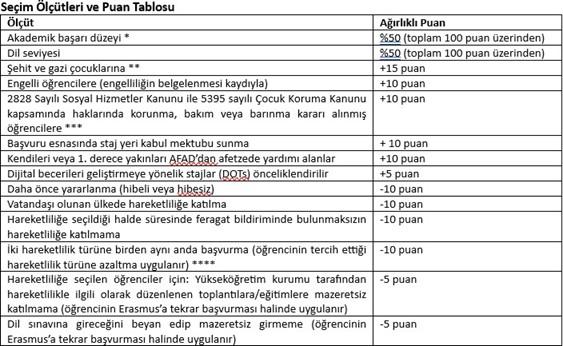
* For the conversion of academic grades from a 4-point scale to a 100-point scale, the “YÖK Grade Conversion Table” will be used as the basis. The relevant table can be accessed via the link below:
https://oyp.yok.gov.tr/Documents/Anasayfa/4lukSistem.pdf
** In addition to combat veterans and their spouses and children, as well as the spouses and children of war martyrs, and in accordance with Article 21 of the Anti-Terrorism Law No. 3713 dated April 12, 1991; public officials who were injured, disabled, killed, or murdered as a result of terrorist acts while performing their duties within or outside the country—even if their official capacity has ceased—as well as the spouses and children of such individuals; and pursuant to Article 7 of Decree-Law No. 667 dated July 23, 2016; spouses and children of those who lost their lives or were disabled as a result of the coup attempt and terrorist act carried out on July 15, 2016, and subsequent related acts, as well as the spouses and children of such individuals, will be given priority if they apply for the Erasmus mobility program.
*** To qualify for priority, the student must submit a letter from the Ministry of Family and Social Policies confirming that a decision has been made regarding protection, care, or shelter for the student under Law No. 2828.
**** If a higher education institution conducts selections for both study and internship mobility within the same application and evaluation process; in the event that a student who has not previously benefited from mobility applies for both study and internship activities simultaneously, the decision regarding which activity the “-10 point” deduction will be applied to is left to the student’s preference. In this case, a written statement is obtained from the student indicating which activity they prefer the deduction to be applied to. If a student who has previously benefited from mobility applies for both study and internship activities simultaneously, a “-20” point deduction is applied to the type of mobility they previously benefited from, and a “-10” point deduction is applied to the second type of mobility they are applying for.
Point deductions are applied to the student’s total score.
If the total scores calculated by considering all criteria are equal, priority is given to the student with the higher academic achievement grade; if the academic achievement grades are also equal, priority is given to the younger student.
The ranking of students is determined within the relevant department or faculty based on the quotas allocated to those departments or faculties.
Requirements Before and During the Application Process:
1- Students must submit their Erasmus Study and Internship Mobility applications through the website prepared by the Turkish National Agency for applications, available at the link below: https://erasmusbasvuru.ua.gov.tr/
2- Every applicant must attend the information session to be held on the date and at the location specified on the first page of this announcement.
3- All documents to be uploaded to the system during the application process must be e-signed or bear a wet signature and seal. Documents obtained from the student information system must be approved by the Office of Student Affairs, and Erasmus Study and Internship Mobility exam results must be approved by the Foreign Languages Coordination Office. No approval is required for documents obtained from ÖSYM and E-Devlet that bear a verification QR code and document control code.
4- Students are responsible for tracking their own Erasmus mobility processes. The contact information they provide during the application must be up-to-date.
5- After submitting the online application, students must submit the following documents to the Erasmus Coordination Office:
i) The mobility application form filled out via https://erasmusbasvuru.ua.gov.tr/
ii) An official, up-to-date transcript
iii) A document showing English proficiency scores
iv) An acceptance letter from the host institution (“Required only for students whose mobility applications have been accepted.”)
v) A decision by the relevant committee or the Learning Agreement for Studies/Traineeships indicating which courses in the student’s home program the courses to be taken abroad (as listed in the Learning Agreement) will be credited toward “Required for students whose mobility applications have been accepted.”
Selection Process and Pre-Mobility:
1- The ranking of Erasmus study and internship mobility applications is evaluated based on the “Selection Criteria and Scoring Table.”
2- Students are ranked by department; the quotas allocated to each department are specified in the “Department Quota Table.”
3- After Erasmus applications are scored via the erasmusbasvuru website, the “Erasmus Commission” convenes and places eligible candidates into the relevant department quotas.
4- Placement results are announced simultaneously on the erasmusbasvuru website and the university’s official website.
5- Students participating in mobility programs must attend the orientation training organized by the Erasmus Coordination Office and obtain the necessary information. Students are solely responsible for any adverse consequences resulting from incomplete information.
6- Students whose mobility applications are accepted are responsible for completing the following documents:
i) Learning Agreement for Studies
ii) Acceptance letter (Host institution
Selection Process and Pre-Mobility:
1- The ranking of Erasmus study and internship mobility applications is evaluated based on the “Selection Criteria and Scoring Table.”
2- Students are ranked by department; the quotas allocated to each department are specified in the “Department Quota Table.”
3- After Erasmus applications are scored via the erasmusbasvuru website, the “Erasmus Commission” convenes and places eligible candidates into the relevant department quotas.
4- Placement results are announced simultaneously on the erasmusbasvuru website and the university’s official website.
5- Students participating in mobility programs must attend the orientation training organized by the Erasmus Coordination Office and obtain the necessary information. Students are solely responsible for any adverse consequences resulting from insufficient information.
6- Students whose mobility applications are accepted are responsible for completing the following documents:
i) Learning Agreement for Studies
ii) Letter of Acceptance (to be obtained from the host institution)
iii) Grant Agreement (to be signed with the Erasmus Coordination Office)
iv) Euro Account Declaration Form
v) Visa Application Letter
7- The Learning Agreement form must be approved by the Erasmus Department Coordinator. This form must include the student’s course selection for the mobility period and must include 30 ECTS credits per semester.
8- The Learning Agreement form must be sent via email to the host institution’s coordination office, and after obtaining the host institution’s signed approval, it must be submitted to the Erasmus Coordination Office.
9- The acceptance letter must be approved by the host institution’s Erasmus Coordination Office.
10- The grant agreement will be signed by the student and the Erasmus Coordination Office, with one copy retained by the student. All details regarding the study mobility process are outlined in this agreement. No deviations from the terms of the agreement are permitted.
11- The student must apply to the relevant country’s consulate with the visa letter approved by the Erasmus Coordination Office and their passport to initiate the visa process. Each student is responsible for managing their own visa process.
12- Once the student receives the visa document, 80% of the mobility grant will be deposited into their Euro account within 30 days.
13- In accordance with Erasmus regulations, the student is required to complete the “Online Linguistic Support (OLS)” test, an English language proficiency exam, prior to the start of the mobility period. The OLS exam will be sent to the student via an electronic invitation and must be taken online before the mobility period begins. The exam result has no impact on the credit load the student is required to take. The OLS test consists of two stages, with the second stage to be taken after the mobility period is completed.
14- In cases where original, signed documents cannot be obtained during the mobility period, scanned documents sent as email attachments will be accepted by the Erasmus Coordination Office.
15- Online documents must be sent to erasmus@gidatarim.edu.tr.
DURING MOBILITY
1- Study mobility must be continuous for at least 3 months. Grant payments may be made for up to 12 months for the relevant project year, depending on the total grant amount allocated to our university. During study mobility, breaks between semesters and official holidays are not considered interruptions.
2- If there is a change in the student’s course selection, the “During Mobility” section of the LAS form must be updated in consultation with the department coordinator at the Erasmus+ host university and subsequently approved by our university’s Erasmus+ Department Coordinator. The LAS form, approved by all parties, must be submitted to our coordinator via email.
3- If a student wishes to extend their study period, they must first submit a written request to our coordinator. Only students enrolled in the Fall Semester Mobility program may apply to extend their study period. Upon approval of the request, the student must contact our university’s Erasmus+ Department Coordinator to prepare a new LAS form for the extended period. The form approved by the department coordinator must also be approved by the Erasmus+ university department coordinator. The LAS form approved by all parties must be sent to our coordinator via email. The request to extend the Erasmus study mobility will be evaluated by the Erasmus Institutional Coordination Office, and the decision—whether funded or unfunded—will be communicated to the student and the Erasmus+ Department Coordination Office.
4- If the student’s study period is extended, a new acceptance letter for the extended period must be submitted to our office via email along with the LAS form.
5- If the student’s study period is shortened, the grant will be reduced on a pro-rata basis. If the study period is extended, the grant will be transferred according to the grant allocated to our university.
6- Except for official holidays at the host institution, if the student is absent from the host institution (city/country) for more than one week while their studies or internship are ongoing, no grant payment will be made for the period of absence. If payment has already been made, reimbursement of the grant amount will be requested.
This process is tracked based on passport entry and exit stamps. If the total duration of the student’s absences from the country at different times exceeds 7 days, a deduction will be made for the entire period of absence.
AFTER RETURNING
1- Student
i) Study Agreement Form
ii) Exchange Transcript
iii) Certificate of Participation
iv) Passport pages showing entry and exit stamps
v) Boarding passes
must be submitted to our office with original signatures and official seals.
2- The LAS form must be fully completed in the ‘Before Mobility’, ‘During Mobility’, and ‘After Mobility’ sections and signed by the relevant parties.
3- If the exchange transcript is not submitted with a signature, it may be sent to our office via email. A copy of the transcript must remain with our office, and the other copy must be submitted to the registrar’s office of the student’s home faculty.
The exchange transcript will be reviewed by the Faculty Council and submitted to the Student Affairs Coordination Office along with the Council’s decision.
4- A copy of the Faculty Council’s decision must be forwarded to our Coordination Office.
5- The student’s recognition procedures will be carried out by the Erasmus+ Department Coordinator and submitted to the relevant faculty for a decision.
6- The “Certificate of Participation” must include the dates of the student’s mobility and be signed and stamped by the Erasmus+ Institutional Coordinator of the host university. Students who fail to submit the “Certificate of Participation” to the Erasmus Institutional Coordinator will not receive the remaining grant payment. The initial payment will be reclaimed, and the program will be canceled.
7- The second stage of the OLS exam must be completed. The exam will be sent to the student via an electronic invitation; students who do not complete the second stage of the OLS exam will not receive the remaining grant payment.
8- To assess the student’s study mobility experience, it is mandatory to complete the “EU Survey,” which will be conducted online. Students who skip this step will not receive the remaining grant payment. The survey will be sent to the student via an electronic invitation.
9- Our office reserves the right to withhold grant payments from students who are found not to have continued their studies, taken exams, and/or fulfilled their responsibilities during their time abroad.
10- The remaining grant payment will be calculated based on the total number of credits the student successfully earned. For a single semester, students who return having successfully earned at least 20 ECTS credits will receive full payment; students returning with 11–19 ECTS credits will not receive the remaining grant. Students returning with 0–11 ECTS credits are obligated to refund the grant they previously received.
11- After the remaining grant is transferred, the student must send the payment receipt to our Coordination Office via email.
12- Provided that the steps outlined above are fully completed, the Erasmus+ study process is considered complete, and the remaining 20% grant payment will be transferred to the student’s bank account.
SCOPE
Erasmus+ Program
The Erasmus+ Program is a European Union initiative designed to encourage cooperation among higher education institutions. It provides partial, non-repayable financial support to enable higher education institutions to develop and implement joint projects, as well as to facilitate short-term student and staff exchanges.
Program Participating Countries
The Erasmus+ Program is open to higher education institutions in the 27 European Union (EU) member states, as well as Iceland, Liechtenstein, and Norway—which are members of the European Economic Area (EEA) but not EU members—and Turkey, a candidate country for EU membership.
To carry out a mobility activity under the Erasmus+ Program, one of the parties must be a university from a country that is a “full member” of the EU. Since Turkey is not yet a member, the partner institution must be from an EU member country; students cannot be sent to universities in EEA countries.
What Is the Purpose of the Program?
The program’s objective is to enhance the quality of higher education in Europe and strengthen its European dimension. The Erasmus+ Program seeks to achieve this objective by promoting international cooperation among universities; facilitating the mutual exchange of students and educators across Europe; and contributing to the academic recognition of studies and degrees obtained in participating countries, as well as the development of transparency.
Who Is Eligible?
· Associate and undergraduate students with a cumulative GPA of at least 2.20 out of 4.00.
· Graduate and doctoral students with a cumulative GPA of at least 2.50 out of 4.00.
Who Is Not Eligible?
· First-year students in associate and undergraduate programs.
· Visiting students (domestic or international)
· Associate and undergraduate students with a GPA of less than 2.20 out of 4.00.
· Master’s and doctoral students with a GPA of less than 2.50 out of 4.00.
Duration of Student Mobility
· Minimum of 3 months
· Maximum of 12 months
Evaluation Criteria and Weights
Student selection will be conducted by identifying the students with the highest scores as Erasmus students, based on the evaluation criteria and weightings announced by the Center among the applicants. The ranking of students is determined separately within each faculty. In the evaluation of Erasmus exam results, the score from the speaking proficiency test will account for 25% of the total foreign language exam score. To be considered successful in the exam, a student’s language exam score must be at least at the B1 (55) level.
The results will be evaluated by the “Erasmus Selection Committee,” appointed by the Rector’s Office, in accordance with the relevant criteria. The selection results will be published on the University and Erasmus Coordination Office’s website.
A student’s receipt of a disciplinary penalty or having a failing grade in a course does not prevent them from participating in the Erasmus program.
Grant Amounts
The monthly grant amounts for Erasmus+ Student Mobility for Studies are specified as follows:
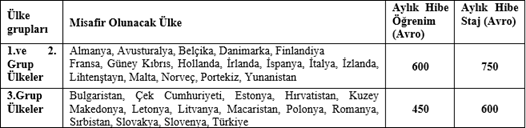
The European Commission reserves the right to make changes to the grant amount.
The allocated grant is intended for support purposes and may not cover all expenses.
· No additional payments will be made from the Erasmus fund for expenses such as the student’s airfare, dormitory fees, dormitory deposit, or health insurance. These expenses must be covered by the student.
· 80% of the Erasmus grant is paid before the student departs for the exchange, and the remaining 20% is paid after the student returns from the exchange.
· The university reserves the right to partially or fully withhold the grant and request the return of any payments made for students who fail to follow the course program specified in the learning agreement or who fail due to non-attendance at classes or other academic activities.
· Students may choose to waive financial support.
· For detailed information about the program, inquiries may be directed to the Erasmus Institutional Coordination Office or the Departmental Coordination Office.
The right to adjust the number of primary and alternate candidates based on evaluation results is reserved by the Erasmus Institutional Coordination Office.
Erasmus+ Special Needs Support
· Erasmus+ places special emphasis on providing guidance, reception, physical access, pedagogical and technical support, and particularly financial contributions toward additional expenses for students and staff participating in Erasmus+ who have physical, mental, or health-related special needs (hereinafter referred to as students and staff with physical, mental, or health-related special needs) and for whom participation in activities would not be possible without additional grant support.
Additional Grant Support for Student/Recent Graduate Mobility
Participants with limited means will be provided with Additional Grant Support in addition to the grant they are entitled to. To be eligible for this grant, a participant with limited means is defined as an individual who is economically and socially disadvantaged and falls under the following subcategories:
1) Those subject to Law No. 2828 (individuals for whom the Ministry of Family and Social Services has issued a decision regarding protection, care, or shelter under Law No. 2828)
2) Students for whom a decision regarding protection, care, or shelter has been issued under the Child Protection Law No. 5395
3) Orphans or those receiving a death pension
4) Spouses and children of martyrs/veterans, as well as veterans themselves
5) Students who submit documentation proving that they, their family, or their legal guardian are receiving support from a public institution (such as municipalities, ministries, Social Assistance and Solidarity Foundations, the General Directorate of Foundations, the Red Crescent, or AFAD) at the time of application
6) Persons with disabilities
7) Individuals covered under Law No. 2022 dated July 1, 1976, regarding the granting of monthly allowances to needy, helpless, and destitute Turkish citizens aged 65 and over, as well as disabled and needy Turkish citizens, where one of their parents or their legal guardian receives a disability or need-based allowance
8) Those who, or whose first-degree relatives, receive disaster victim assistance from AFAD.
Additional Grant Support Amount: 250€ per month
Travel Support
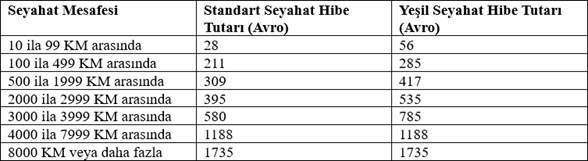
To contribute to students’ travel expenses, the distance between the starting point of the mobility and the location where the activity takes place must be determined using the distance calculator provided by the European Commission, and the travel grant must be calculated using the table below. The grant amount shown in the table corresponds to the round-trip distance in kilometers as calculated by the distance calculator; this amount is not multiplied by two.
What Is a Special Access Need?
· Areas where support may be appropriate for individual needs related to Erasmus+ mobility include, but are not limited to: assistance with suitable accommodation and travel, medical accompaniment, assistive devices, reasonable study costs, and a companion.
How to Apply?
· Requests for assistance with the Erasmus+ Special Needs Support Application Form should be submitted to the university’s Erasmus+ Coordination Office or the Departmental Erasmus Coordinator. Applications will be forwarded to the National Agency by the Erasmus+ Coordination Office.
QUOTAS
The list of partner universities and their quotas under the Erasmus+ KA131 Individual Learning Mobility program is available at the link below. The Erasmus+ Institutional Coordination Office reserves the right to update the quota table within the announcement period if new agreements are established.
The estimated quota for students receiving grants is 8.