

Pixel-Based Visualization of DNA Sequences: A Chaos Theory and Deep Learning Approach
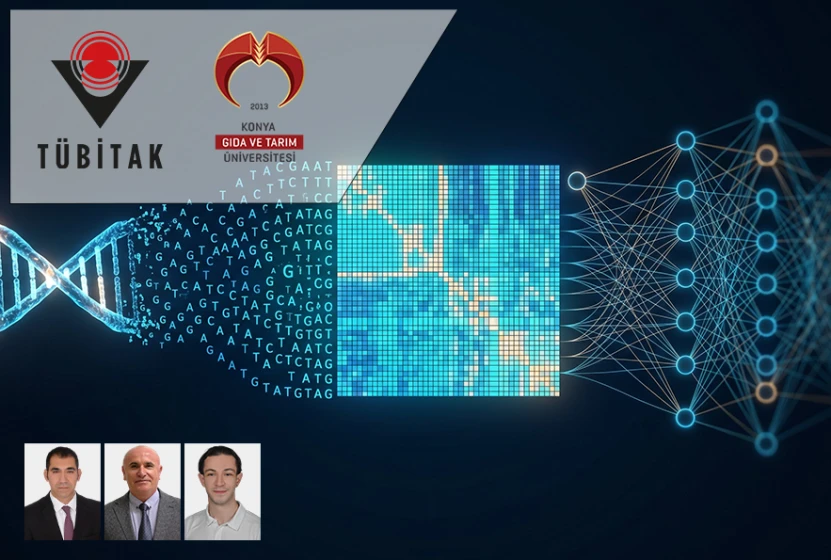
The research project prepared under the coordination of Tolga TÜRKMEN, a 4th-year student of the Management Information Systems Department at our university, with the advisory of Dr. Ayhan AYDOĞDU and the scientific leadership of Prof. Dr. Kıvanç BİLECEN, has been awarded support within the scope of TÜBİTAK 2209-A University Students Research Projects Support Program.
Within the scope of the project, instead of conventional text and character-based sequence alignment algorithms commonly used in genetic research, a mathematical modeling approach based on Chaos Theory is employed to visualize DNA sequences as two-dimensional pixels. This innovative approach is capable of capturing even the smallest structural differences of as little as 1% between DNA sequences as micro-level visual density variations, which are then analyzed using advanced artificial neural networks.
Based on the results to be obtained, it is planned to overcome the processing time and high memory consumption barriers created by conventional systems working on massive datasets consisting of more than half a million sequences. Thanks to the developed hierarchical search and intelligent hardware utilization architecture, the biological significance of minimal genetic variations between sequences will be detectable at a much higher computational speed.
Ultimately, this innovative computational infrastructure — which successfully integrates artificial intelligence, big data analytics, and high-performance computing (HPC) dynamics within the bioinformatics ecosystem — is expected to bring a contemporary and innovative direction to our national genetic research endeavors.